
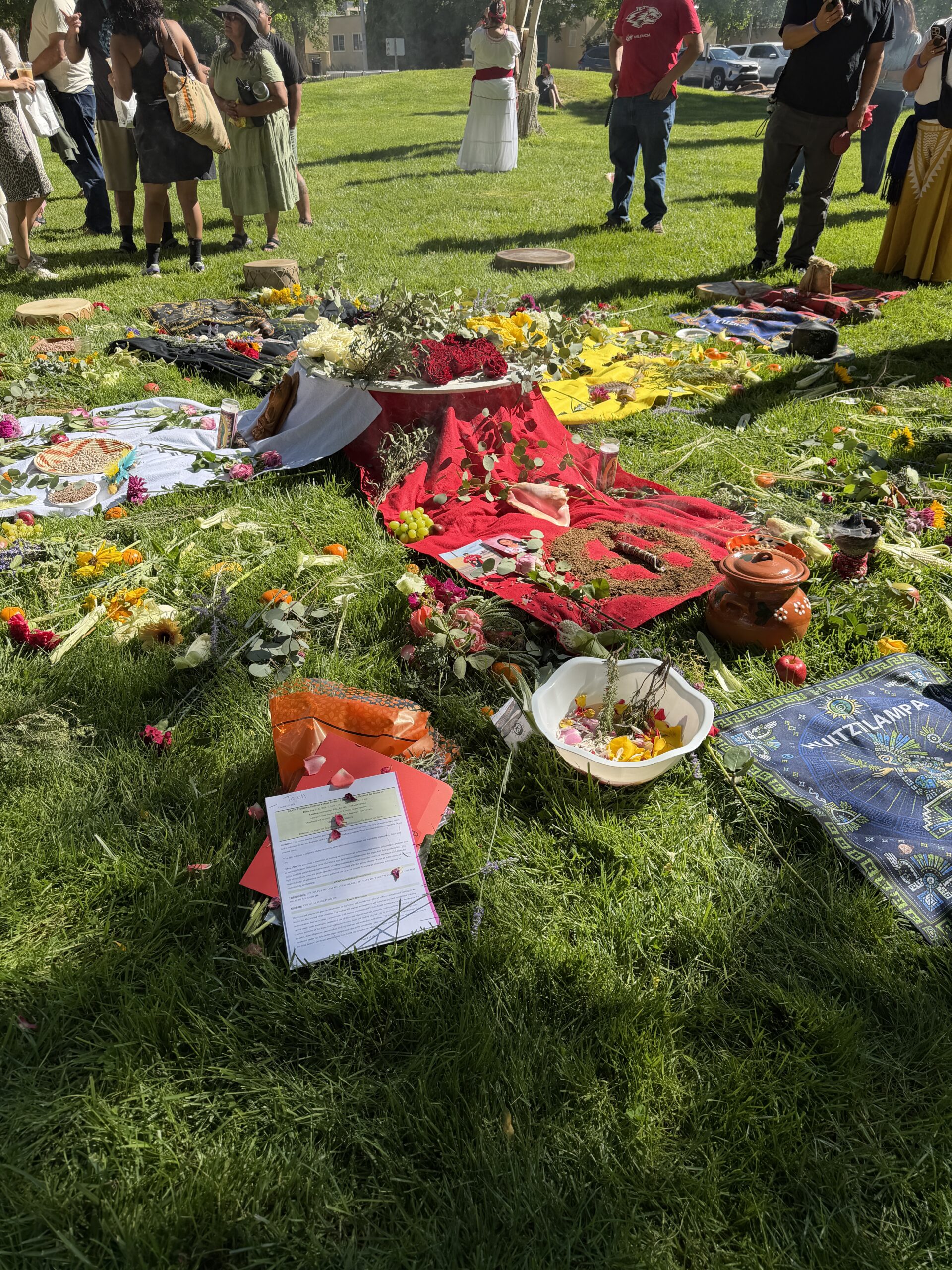
If you grew up in a Mexican household, chances are someone has looked at you and said,
“Mija…you need a limpia.”
Not because you were cursed.
Not because someone put a hex on you.
Just because you looked…off.
Maybe you’d been crying for days.
Maybe everything in your life seemed to be going wrong.
Maybe you were carrying stress you couldn’t explain.
In my family, nobody debated whether limpias “worked.” You just did them.
Growing up, they weren’t presented as mystical or symbolic. They were practical. Just another way of caring for yourself when life became too heavy to carry alone.
Then I became a scientist.
Like many first-generation kids, I learned to compartmentalize. There was the world of my ancestors, and there was the world of academia. One belonged at family gatherings. The other belonged in the lab.
By the time I started my PhD in neuroscience, I honestly thought I’d left those traditions behind.
Until graduate school broke me.
Anyone who’s been through a PhD knows the kind of stress I’m talking about. The deadlines. The uncertainty. The politics. The constant feeling that if you stopped moving for one second, everything would fall apart.
My body never relaxed.
I wasn’t just mentally exhausted. My nervous system was completely dysregulated.
And during one particularly difficult season, all I wanted was the rituals I grew up with.
Not because I had stopped believing in science.
Because my body was asking for something my brain couldn’t explain yet.
Ironically, while I was studying the nervous system for my dissertation, I realized something that completely changed how I saw my own culture.
These worlds weren’t contradicting each other.
They were describing the same phenomenon using different languages.
Indigenous science has always been science.
Here’s something I’ll say unapologetically:
Indigenous science is science.
Our ancestors didn’t have MRIs.
They didn’t know the word “amygdala.”
But they spent thousands of years observing human behavior with incredible precision.
Look across cultures and you’ll find cleansing rituals almost everywhere:
Smoke.
Water.
Prayer.
Sound.
Herbs.
Touch.
Different symbols. Same nervous system.
What fascinates me isn’t that these traditions exist.
It’s that so many of them independently discovered practices that modern neuroscience now recognizes as powerful tools for regulating stress.
Your brain is constantly asking one question.
Your nervous system has one primary job:
Am I safe?
Every second of every day, your brain is scanning your environment for signs of danger.
When you’ve been under chronic stress, your brain gets really good at finding threats—even when they’re no longer there.
Your amygdala becomes more reactive.
Your body stays tense.
Your thoughts become louder.
Everything starts to feel urgent.
When you’re stuck in that state, you don’t need better advice.
You need regulation.
Because a dysregulated brain isn’t interested in insight.
It’s interested in survival.
So what is a limpia actually doing?
This is where I think neuroscience offers a beautiful explanation. A limpia isn’t magic because herbs have supernatural powers. It’s powerful because it’s a structured sensory ritual.
Think about what’s happening. Someone moves intentionally around your body. There’s repetitive motion.
There’s touch. There’s scent. There’s Prayer. Sometimes music.
Sometimes smoke. Everything about the experience is slow, rhythmic, and predictable.
Those are exactly the kinds of sensory inputs that help tell the nervous system,
“You’re safe now.”
Once your brain begins shifting out of survival mode, your prefrontal cortex—the part responsible for decision-making, emotional regulation, and perspective—can come back online.
In other words…
Regulation comes before clarity.
Every single time.
Why herbs, smoke, and eggs feel so powerful
One of my favorite things about neuroscience is that it explains why these traditions feel so immediate. Smell is one of the only senses with a direct pathway into the brain’s emotional centers. That’s why one familiar scent can instantly transport you back to childhood. Touch grounds us in our bodies when anxiety pulls us into endless thinking. Rhythmic movement gives the brain predictability, and predictability helps reduce uncertainty.
Even an egg limpia makes psychological sense.
Whether or not you believe the egg absorbs energy, the ritual asks your brain to place an invisible emotional experience into something tangible.
Instead of carrying everything internally, you can literally see your stress outside of yourself.
Sometimes that’s exactly what the brain needs to begin letting go.
But here’s the part people don’t always want to hear.
A limpia won’t fix a relationship that keeps hurting you.
It won’t make your boss less toxic.
It won’t magically create boundaries you’ve been avoiding.
Sometimes what we call “bad energy” is actually information.
It’s your body saying,
“This environment isn’t safe anymore.”
A ritual can help calm your nervous system enough to hear that message.
But you still have to act on it.
That’s where healing happens.
Not just in the ceremony.
But in the choices you make afterward.
The sacred and the scientific can coexist.
People often ask me if neuroscience has made me less spiritual. It’s actually done the opposite. The more I study the brain, the more respect I have for ancestral knowledge.
Science doesn’t diminish these traditions. It gives us another language for understanding why they have endured for generations. Maybe our ancestors didn’t explain the vagus nerve. But they understood that people needed rituals to return to themselves.
And honestly? I will trust that until the end of my days.
Don’t forget to stay curious, stay connected, and always trust your gut.
💌 Dear LaTarotina
Do you have a question about spirituality, ancestral practices, relationships, or navigating modern life without losing your roots?
Every month I’ll answer one anonymous question by bringing together neuroscience, psychology, and the wisdom passed down through our communities.
Because reclaiming our traditions doesn’t mean leaving science behind. Sometimes it means asking better questions of both.
Submit your question anonymously and it may be featured in an upcoming Dear LaTarotina column.
— Latarotina
Bianca is a neuroscientist, practictioner of curanderismo, tarot practitioner, and the founder of LaTarotina.